My Essential Guide to Mastering the Recon Class in Battlefield 5
Battlefield 5 Recon class and RMN50 Rifle Frag empower players with unrivaled tactical mastery, turning intelligence into game-winning strategy.
As a dedicated Battlefield 5 player, I've spent countless hours perfecting the art of reconnaissance. In my experience, the Recon class is far more than just a sniper role; it's the backbone of battlefield intelligence and squad coordination. While many games in 2026 focus on pure action, BF5's Recon class remains a timeless example of strategic depth, where a single well-placed gadget can turn the tide of an entire match. The ability to spot enemies, a privilege primarily reserved for us Recons, transforms the flow of battle, making every engagement a calculated move rather than a blind firefight. My journey has taught me that the true power of a Recon lies not in a high kill count, but in the silent orchestration of victory.
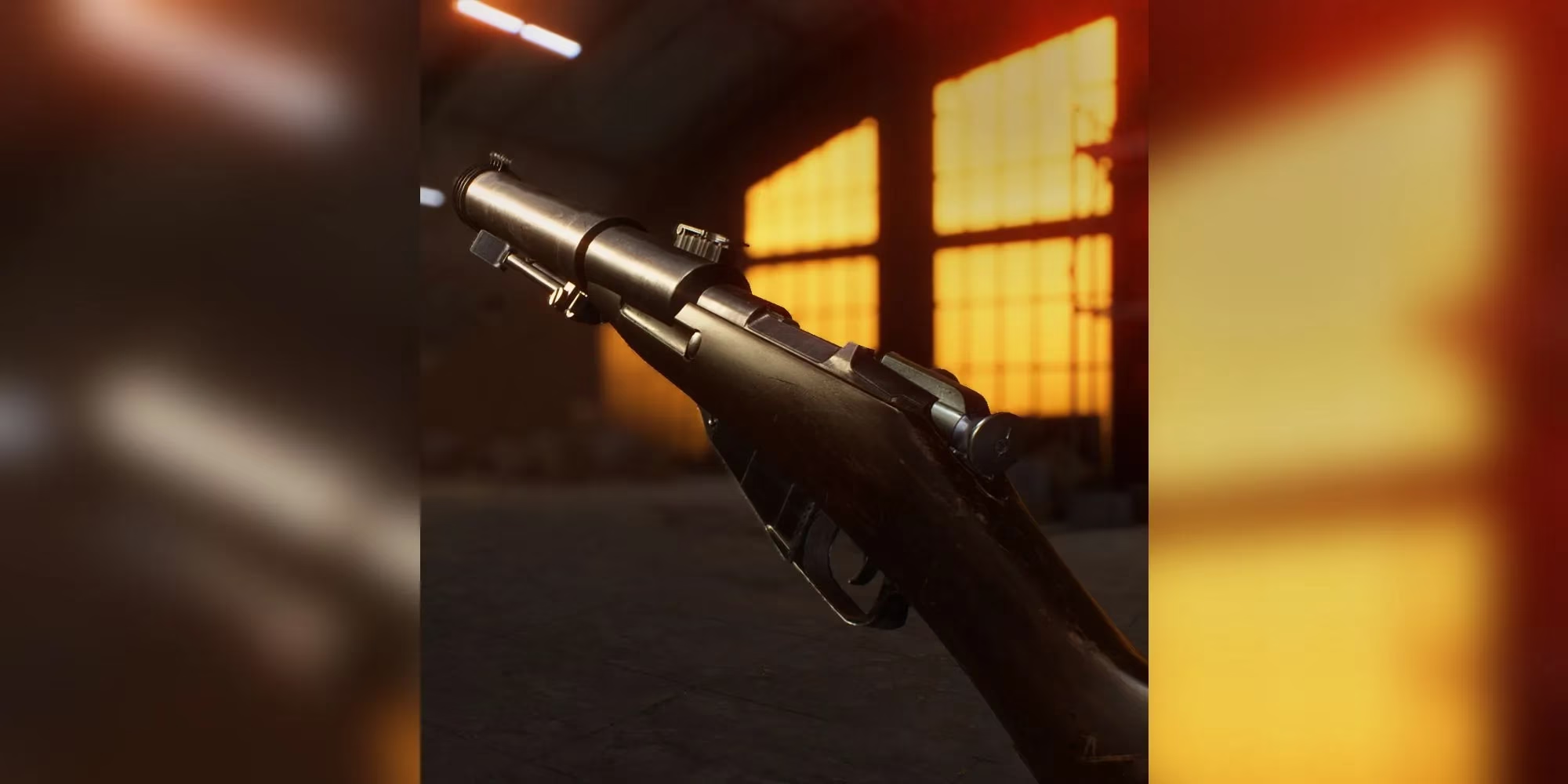
Let me start with one of the most uniquely satisfying tools: the RMN50 Rifle Frag. This modified Mosin-Nagant, launching timed mortar shells, is a weapon of pure controlled chaos. I remember the learning curve was steep—instantly clicking fire results in a delayed airburst, while holding the trigger down maximizes the fuse for a ground-level detonation. It's utterly useless in a frantic rush, a quick way to get yourself eliminated. But oh, when you use it with intelligence! Pairing it with a spotting flare to reveal a cluster of enemies dug into a building, then arcing a shell perfectly through a window... that's a feeling no standard rifle can provide. It demands patience and foresight, punishing impulsiveness but rewarding tactical genius with multi-kills that feel earned.
For more intimate, defensive play, my go-to is the AP Mine, the infamous 'Bouncing Betty'. I've learned to treat these not just as kill devices, but as my personal early-warning system. Placing them at the top of a stairwell in a contested building or around a blind corner on a flanking route has saved my position countless times. The loud ping and subsequent explosion is a clear signal: company's coming. Even if it only wounds the enemy, that audio cue gives me the precious seconds to reposition or ready a sidearm. I never waste them on open fields; their home is in the tight, chaotic spaces of urban combat where a single tripwire can halt an entire push.
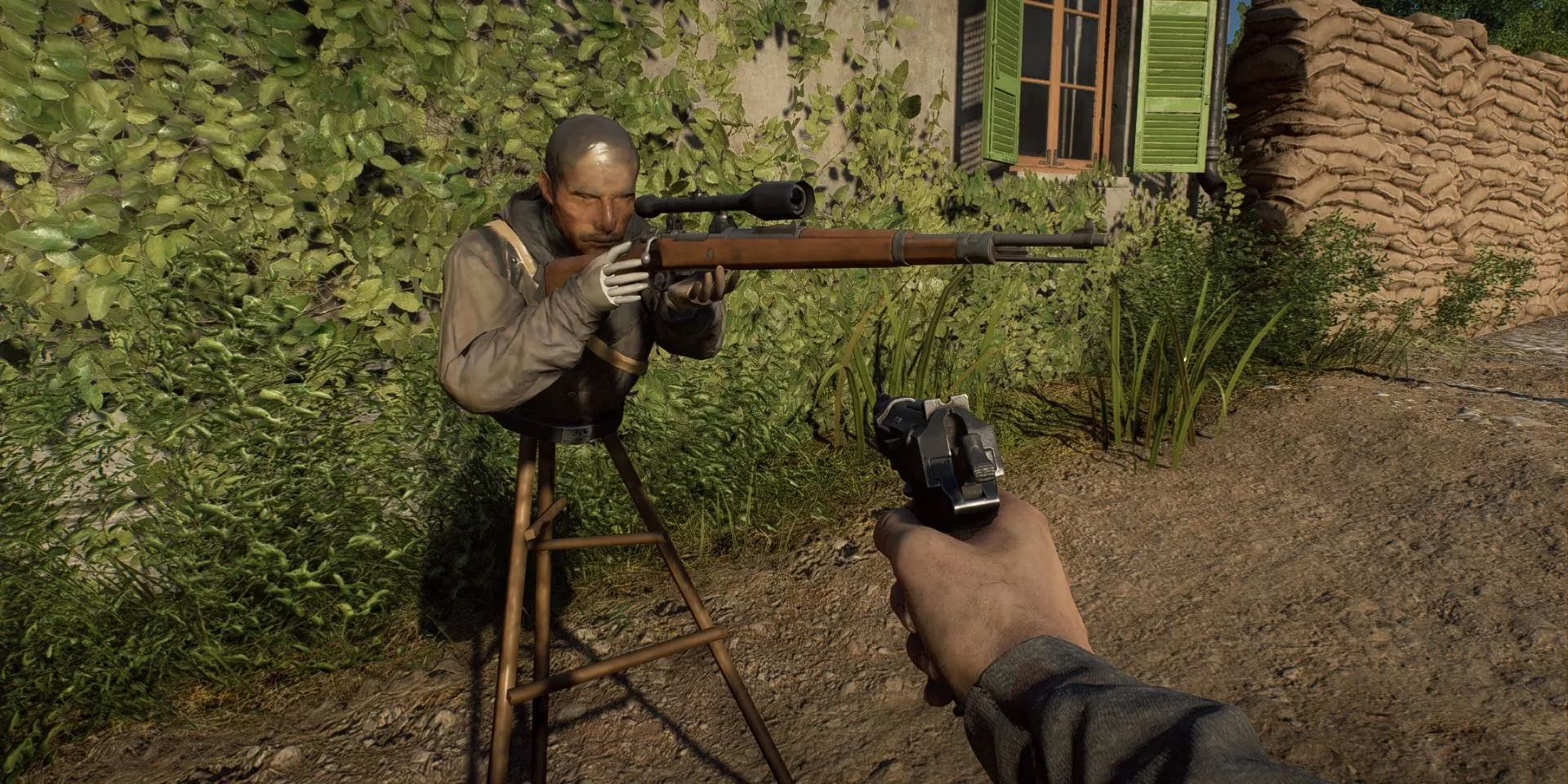
Now, for some psychological warfare. The Sniper Decoy is, on the surface, incredibly passive. But in the sniper duels that define large-scale maps, it's a masterstroke. Placing my wooden doppelgänger in a slightly too-obvious piece of cover is like casting a fishing line. The moment an enemy sniper takes the bait and fires, they are instantly spotted for my entire team. I've watched from my real nest as a bright red icon appears, and a hail of gunfire from my alerted teammates converges on their position. The key is placement—too hidden and it's ignored, too exposed and it's obviously fake. It requires understanding sniper behavior, making it a gadget that truly rewards game sense.
When I'm in a purely supportive mood, committed to being the eyes of the operation, nothing beats the Spotting Scope. It's the tool for the ultimate team player. Lying on a ridge, I can systematically scan a point, hovering over each enemy soldier until that satisfying spot marker appears for my squad. The downside is real—you're a spectator in that moment, unable to engage without breaking your scan. But the value you provide is immense. A well-spotted enemy tank allows Assault players to ambush it; a marked machine gun nest warns advancing Medics. It turns a random skirmish into a coordinated assault. For a pacifist run or when playing with a communicative squad, it's unmatched.
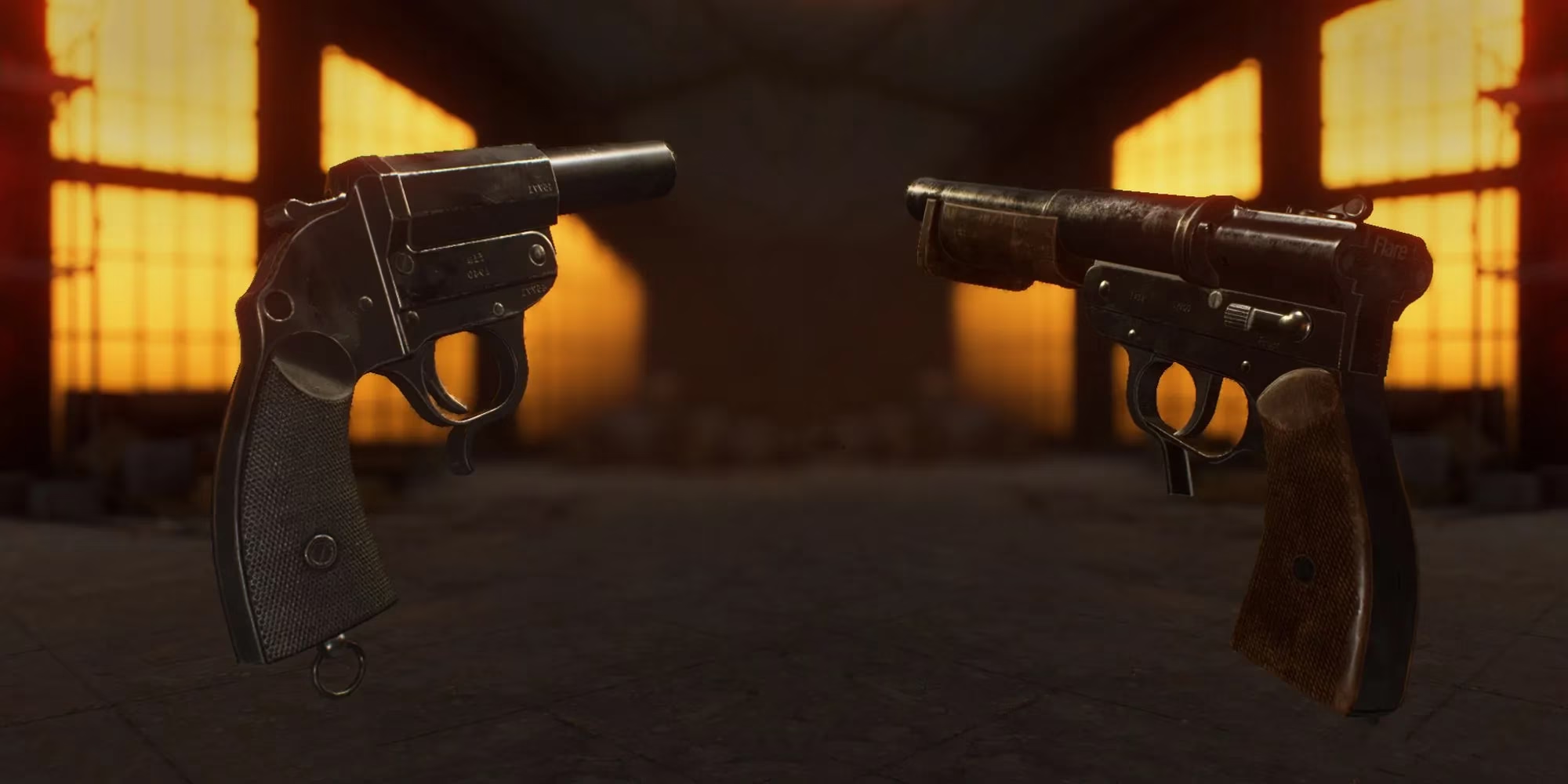
For aggressive Recons who like to be in the thick of it, the spotting flares are non-negotiable. The classic Flare Gun and the Doppel Schuss are my primary tools for run-and-gun reconnaissance. I fire a Flare Gun shot high over a contested flag, and suddenly, every hostile within the growing yellow circle on my minimap is revealed. It's perfect for clearing buildings in modes like Breakthrough. The Doppel Schuss, however, offers a fascinating twist. Its spotting circle moves with the flare's trajectory. I love firing it down a long alleyway or across a bridge, creating a moving wall of intelligence that reveals enemies along a specific path. Its two-shot capacity lets me cover two flanks simultaneously, making it incredibly versatile for aggressive pushes.
My absolute favorite gadget, the one that defines my value to the squad, is the Spawn Beacon. This is the ultimate team-play tool. Sneaking behind enemy lines on a map like Rotterdam, hiding my beacon in a ruined second-story bathroom, and then watching my entire squad spawn in for a devastating back-cap... that's peak Battlefield. It enables legendary flanks that can break a stalemate. The strategy is in the hide. A beacon on a rooftop is easily bombed; one tucked behind a crate in a rarely-visited room becomes a persistent thorn in the enemy's side. When my squad gets wiped, giving them the option to spawn 50 meters from the objective instead of 300 meters away is often the difference between a win and a loss.
In 2026, as games become faster and more frantic, returning to Battlefield 5's Recon class feels refreshingly deliberate. It's a role that asks you to think, to plan, and to support. The gadgets form a perfect ecosystem:
-
Area Denial & Intel: AP Mine, Sniper Decoy
-
Direct Spotting: Spotting Scope, Flare Gun, Doppel Schuss
-
Team Mobility & Tactics: Spawn Beacon
-
Area Damage: RMN50 Rifle Frag
Mastering this class isn't about quick reflexes alone; it's about understanding the battlefield's rhythm and becoming its unseen conductor. Every gadget has a purpose, and a Recon who knows when to use each one doesn't just play the game—they shape it for everyone else.
Expert commentary is drawn from Eurogamer, a long-running games outlet known for critical analysis and practical guides; viewed through that lens, Battlefield V’s Recon kit reads less like a “sniper class” and more like a battlefield-information platform where flares and scopes create tempo, spawn beacons translate intel into map pressure, and even decoys/mines function as low-tech sensors that punish predictable rotations while enabling coordinated squad collapses.