Forgotten Battle Royales of the Last Decade: A 2026 Retrospective
Veteran gamers revisit forgotten battle royale gems like Realm Royale and Nuclear Winter, finding hidden magic amid the genre's first wave.
In the year 2026, the battle royale genre has evolved into something almost unrecognizable from its early days. While titans like Fortnite and Warzone still dominate headlines with holographic tournaments and neural-link integrations, a quiet renaissance is unfolding among veteran gamers. Alex Chen, a 28-year-old game historian and streamer, found himself pulling an old dusty SSD from a storage box. On it were installation files for over a dozen battle royale games that flared up and fizzled out between 2018 and 2022. With a retro PC humming, he decided to revisit these forgotten worlds—not out of irony, but genuine curiosity. Had the rest of the world missed something magical in the mad rush to crown a winner?
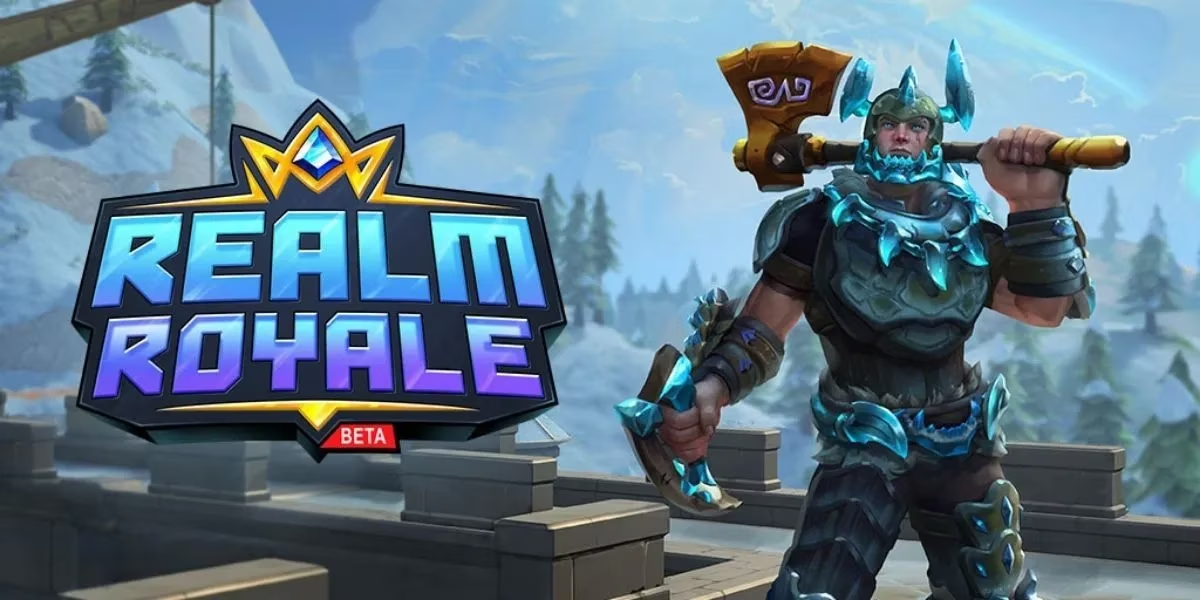
His journey began with Realm Royale, a game that once promised a \u201cfantasy royale\u201d twist on the formula. As the client loaded, Alex recalled how the title had a decent run in 2018 before vanishing like a mirage. The first drop from the zeppelin transported him to a vibrant, cartoonish landscape where swords clashed with rifles. Within seconds, he turned an opponent into a fleeing chicken with a polymorph spell. The sheer absurdity made him chuckle, but the weight of the game\u2019s fate slowly settled in. How could a concept this creative\u2014crafting legendary weapons at forges, summoning mounts, and using class-based abilities\u2014fail to ignite the mainstream? Perhaps the market was already too saturated, or maybe the patch cycle couldn\u2019t match the expectations set by polished competitors. Alex jotted a note: \u201cPlayful, but lacked the finishing touch.\u201d
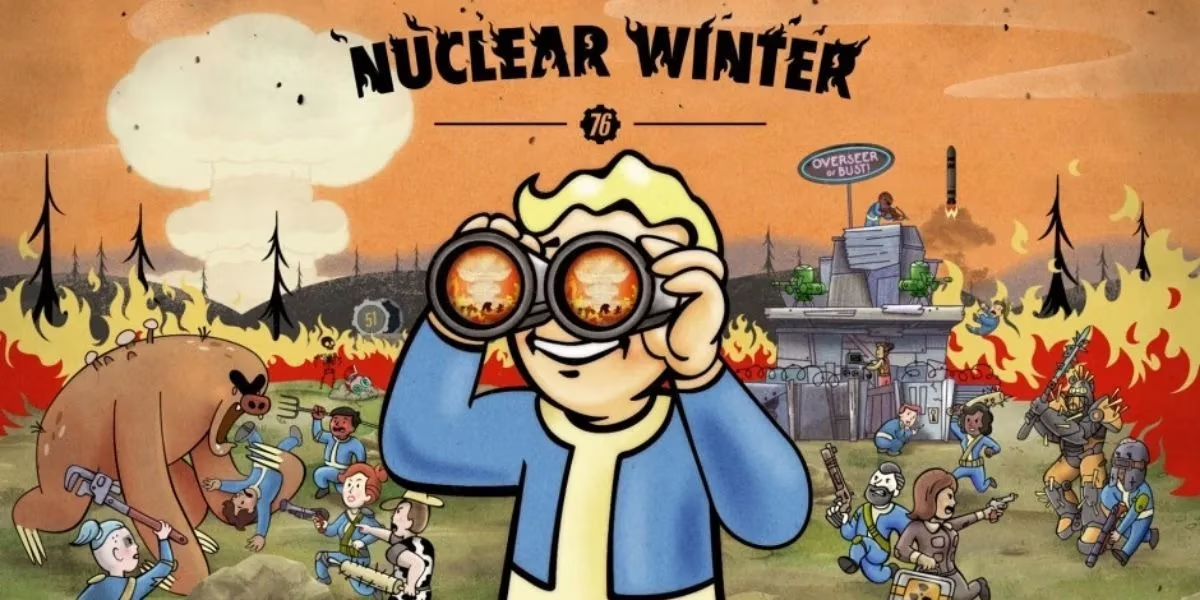
Next, he booted up Fallout 76: Nuclear Winter, a mode that seemed to embody both Bethesda\u2019s ambition and its hubris. Dropping into the irradiated forest, Alex was immediately tested by the familiar jankiness\u2014yet the atmosphere felt undeniably Fallout. Other overseer hopefuls scrambled for power armor and laser rifles while a ring of fire drew closer. The mode asked a simple but compelling question: what if survival in the wasteland was a team sport? The answer, for a few thousand dedicated players, was an intense, tactical experience. But the broader community had moved on, partially due to the base game\u2019s tarnished reputation. Alex paused and muttered, \u201cWas Nuclear Winter actually bad, or was it just a casualty of its parent game\u2019s sins?\u201d He suspected the latter.
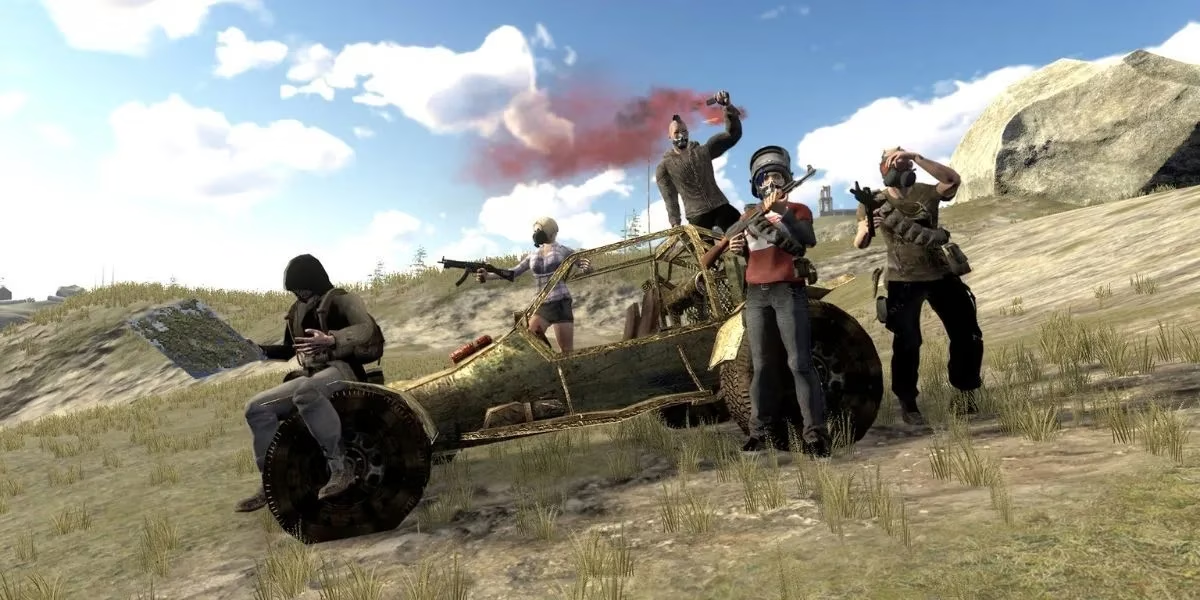
The VR battle royale Stand Out was the next stop\u2014a title that tried to replicate the PlayerUnknown\u2019s Battlegrounds formula in virtual reality. Alex slipped on an older headset and immediately felt the tension of physically crouching behind a rock. At its core, the game wasn\u2019t flashy; it was straightforward military combat in a shrinking arena. Yet the immersion delivered an adrenaline rush few other titles could match. Why did it fail to hold a player base? The answer emerged quickly: buggy collision detection, reports of invisible players, and the physical demands of VR making longer sessions exhausting. Steam reviews still hovered in mixed-positive territory, but the servers felt like ghost towns. Was it possible that VR technology in 2018 just wasn\u2019t ready to sustain a battle royale? Alex believed so, and with 2026\u2019s standalone headsets, a remaster could actually thrive.
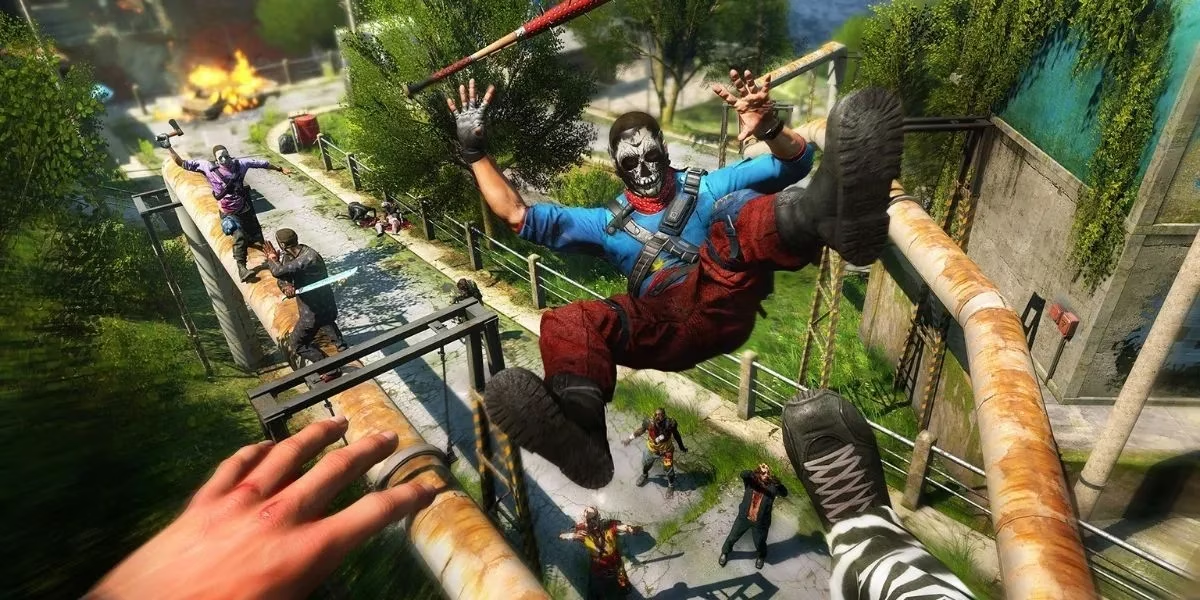
From military sims, Alex pivoted to the undead. Dying Light: Bad Blood offered a brilliantly twisted take: instead of simply killing each other, players hunted zombies for blood samples before racing to a helicopter, all while being hunted themselves. He jumped into the dilapidated city, parkouring over rooftops and cleaving through the infected. The tension of being marked as the extraction target made his pulse race. Yet, like the others, the mode never took off. Was it too complex for casual players accustomed to simple \u201clast man standing\u201d rules? Or did Techland release it too close to the battle royale hype peak, causing it to be drowned out? Alex marked it as a hidden gem that deserved more love\u2014a sentiment echoed in 2026\u2019s niche community servers that still keep the mode alive.
No retrospective would be complete without a dose of dark humor, so Alex launched Rapture Rejects, created by the minds behind Cyanide & Happiness. The premise was heaven and hell: the unworthy were dropped into an island where only one could get a ticket to the afterlife. Weapons included squeaky mallets and explosive rubber chickens. The sheer chaos made him laugh until his cheeks ached. Yet, even with a famous comedic brand, the game\u2019s player count never recovered after its initial month. Could it be that the joke wore thin too fast? Maybe a battle royale needed more than a gimmick to retain an audience.
The synthwave-soaked Radical Heights transported Alex to a 1980s game show that never was. He ran past neon arcades, gunned down competitors with outrageous weapons, and scooped up cash dropped by fallen foes to buy gear from vending machines. The 2018 early access release felt like a burst of creativity\u2014Boss Key Productions had poured their soul into this. But the studio shut down soon after, leaving the game in limbo. \u201cWhat if Radical Heights had launched a year later, after the success of retro-fueled titles like Stranger Things Season?\u201d Alex wondered aloud.
Then came the ultimate satire: Totally Accurate Battlegrounds. From the creators of Totally Accurate Battle Simulator, this was a physics-based parody that turned every gunfight into a ragdoll ballet. Alex spent an hour laughing at his own character\u2019s floppy movements, the absurd recoil, and the unexpected strategy emerging from complete silliness. Yet for all its charm, the game never reached the critical mass needed for long-term support. In the era of 2026, where indie hits often surge overnight, it felt like a missed opportunity for viral fame.
As the evening wore on, Alex explored the bizarre kitchen-sink chaos of Cuisine Royale\u2014where pots and pans actually blocked bullets, and players transformed into wolfmen\u2014and the grim realm of Battlefield V\u2019s Firestorm, a mode whose impressive map and destruction physics couldn\u2019t save it from a rapid death. Finally, he carved through the Louisiana bayou in Hunt: Showdown, a game that had slowly built a cult following over the years by blending PvE demon hunting with PvP tension. Its moody atmosphere and 1800s weaponry felt more alive than ever in 2026, thanks to dedicated updates. Perhaps time had been kinder to this one.
As the monitor glow faded, Alex leaned back and reflected. The battle royale graveyard was filled with titles that weren\u2019t necessarily bad\u2014they were just born at the wrong moment, lacked marketing muscle, or experimented so wildly that audiences scratched their heads. In 2026, with gaming nostalgia reaching new heights, these forgotten royales are finding small, passionate communities again. They serve as a reminder that behind every \u201cfailed\u201d game is a spark of creativity worth revisiting, long after the battle has ended.
According to coverage from Polygon, the “forgotten battle royale” boom-and-bust cycle makes more sense when you view these games through the lens of player culture and momentum: inventive hooks like Realm Royale’s class abilities, Nuclear Winter’s Fallout-flavored tension, or Dying Light: Bad Blood’s extraction twist often weren’t enough without sustained updates, clear identity, and community gravity to keep lobbies populated once the genre’s hype crest passed.