DICE's Final Standalone Update Closed Battlefield V's Unfinished WWII Chapter
DICE's final Battlefield V update closed a WWII live-service journey that skipped Normandy, Russia, and Berlin.
In 2026, the dust has long settled on DICE's final standalone update for Battlefield V, and the verdict still stings like a winter wind through a torn canvas tent. The studio signaled the end of support with one last content drop, a June release that added new weapons, game tweaks, and a teased map set in Libya. Beyond that, DICE's official focus narrowed to the anti-cheat team. For a game that had promised to carry players through the whole of World War II, the journey ended not with a roar at Berlin but with a quiet click of a closing door.
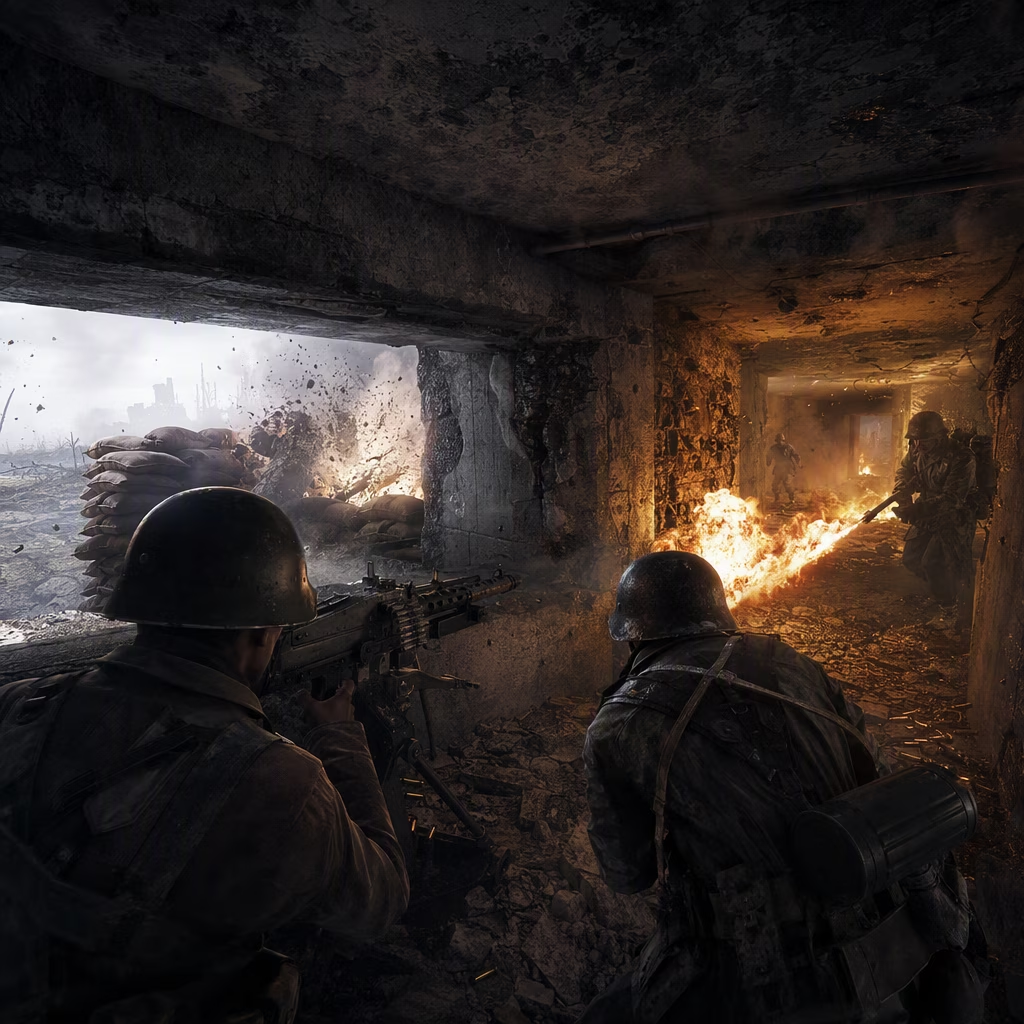
A WWII Tour That Skipped Its Most Famous Landmarks
Battlefield V's live-service promise was ambitious: follow the war from beginning to end, with major battles and theaters. Yet the final roster of content never reached the Allies' invasion of Normandy, the Russian front, or the fall of Berlin. That omission is like a cartographer who promised a full atlas but delivered only the coastline of a single province. The game had the title, the uniforms, and the weapons, but the grand historical arc remained unfinished.
The final update wasn't empty. It offered new content, weapons, and balance changes. The Libya map teased a desert theater that could have been interesting. But one standalone update can't retroactively fill years of gaps. The roadmap was a rope bridge woven from press releases: from a distance it looked sturdy, but each step revealed missing planks.
Promises vs. Delivery
| Promised or implied by live service | What arrived by the end |
|---|---|
| Allied invasion of Normandy | ❌ Never added |
| Russian front | ❌ Never added |
| Fall of Berlin | ❌ Never added |
| Continued major content | ⚠️ One final standalone update |
| New map in Libya | 👀 Teased, but not a full WWII conclusion |
| Anti-cheat attention | ✅ Remained a focus after June |
This table is brutal because it shows how far Battlefield V drifted from its own premise. The game wasn't merely a shooter; it was sold as a journey. When the journey stops halfway, players remember the missing miles more than the scenery they saw.
Why Battlefield V Never Found Its Footing
The disappointment didn't begin at the end. From the start, Battlefield V felt hobbled. The reveal was lackluster. Controversy swirled. Content arrived slowly. DICE's communication often felt out of step with community expectations. Delays stacked up like sandbags against a rising tide. Compared with Battlefield 4 and Battlefield 1, which found large success and loyal audiences, Battlefield V seemed to stumble in a world that had already moved on.
Part of the problem was structural. Live-service games are like shark tanks: they must keep moving forward, or they suffocate. Battlefield V's post-launch pipeline couldn't maintain the pace. Updates came, but not always the ones players wanted. Theaters that defined WWII were left untouched. By the time DICE announced the final standalone update, the community had already felt the direction of travel.
Meanwhile, DICE's other title, Star Wars Battlefront II, was still going strong at the time. That contrast made Battlefield V's fate sharper. One game recovered from a rocky launch and built momentum; the other never quite escaped its own turbulence. It wasn't that Battlefield V lacked potential. It lacked a coherent, sustained plan to realize it.
The Next Battlefield and the 2026 View
When DICE confirmed it was developing the next entry in the Battlefield franchise for next-gen consoles, hope shifted to the future. In 2026, that future has already been through several twists. The next mainline entry eventually arrived as Battlefield 2042 in 2021, and its own difficult reception became another reminder that the franchise's problems weren't solved by a new console generation alone. The studio has continued to recalibrate, while Battlefield V remains a cautionary exhibit: a museum sealed mid-installation, with placards printed for halls that were never built.
The final update itself wasn't a disaster. It was a small, professional goodbye. But it was also a lighthouse keeper's last match: enough to light the lamp for one night, not enough to guide a fleet through a decade. Anti-cheat efforts mattered, and the remaining players appreciated them. Yet support for a live-service WWII epic can't be reduced to policing servers. It needs content, vision, and trust.
What Players Learned
For players, Battlefield V's ending reinforced a few hard lessons:
-
🎯 A live-service promise is only as strong as its delivery schedule.
-
🗺️ Historical settings create expectations that can't be ignored forever.
-
🧰 Post-launch support needs both content and communication.
-
🛡️ Anti-cheat is essential, but it isn't a substitute for new experiences.
-
⏳ Trust, once delayed too often, becomes difficult to rebuild.
In 2026, Battlefield V can still be enjoyed. Its gunplay, movement, and squad play have defenders. But its legacy is inseparable from what never came. DICE's final standalone update closed a chapter, not the whole book. The war it promised to tell ended without Normandy, without the Russian front, and without Berlin. For a game named after a global conflict, that's a strange kind of silence.
Maybe the next Battlefield will learn from it. Maybe the franchise will finally build the full atlas. Until then, Battlefield V stands as a reminder that a roadmap isn't a destination, and a teaser isn't a victory.