Battlefield V: A Cautionary Tale of Live-Service War
Battlefield V, DICE and EA's rushed WWII shooter, crumbled under controversy, broken roadmaps and TTK missteps, ending support in 2020.
In the summer of 2020, EA and DICE lowered the flag on Battlefield V, announcing that the game would receive one final content update before support ended. For a shooter that had once promised to carry the Battlefield legacy into World War II, the news landed not as a shock but as a quiet confirmation. By then, the game had spent roughly eighteen months stumbling from one controversy to the next, a live-service campaign fought on a battlefield of its own making. In 2026, the silence around Battlefield V is total: no new patches, no seasonal dreams, no last-minute miracles. It stands as a monument to what happens when a proud franchise is rushed into a war it was never equipped to win.
A Reveal That Started a Fire
On May 23, 2018, DICE released the first reveal trailer for Battlefield V. The response was immediate and volcanic. Fans and critics tore into the game for abandoning the more authentic tone of earlier entries in favor of something that looked arcade-like, stylized, and oddly disconnected from the grit of World War II. Some criticisms were fair: players wanted the series to remain a semi-authentic portrayal of historical conflict. Others were ugly and unjust, with certain groups aiming misogyny and racism at the developers. The game became contentious more than half a year before release, and the marketing cycle was marred by executives course-correcting and making promises that would never be kept.

A later trailer adopted a more nostalgic tone, and for a moment, DICE salvaged some goodwill. It was a brief candle in a hurricane. When Battlefield V launched, it arrived incomplete. Battlefield games had a reputation for rough launches—Battlefield 4 took over a year to fix its server bugs—but Battlefield V lacked the expansive, unique backbone that had justified Battlefield 4's chaos. For many, it felt like a re-skin of Battlefield I with a mediocre amount of content. The map roster was smaller than any prior Battlefield game, and the content roadmap stalled almost immediately.
A Roadmap Like a Sundial in a Thunderstorm
The roadmap was a sundial in a thunderstorm—technically a guide, practically useless. Controversial balancing changes fundamentally restructured the TTK (Time-To-Kill) of nearly every weapon, forcing players to relearn their favorite guns. Then, bafflingly, DICE did it again, altering the way the game played for those who remained. Bugs infested every facet: inconsistent footstep audio, high skin prices, slow currency earning, constant crashes, and a plague of loot boxes in the store. Everything about the game seemed destined to be seen as another EA cash-grab, released with barely enough features to qualify as a full-priced title.
And yet, Battlefield V still had a promising core. The shooting was solid. The revamp of various systems was neat. Players could build fortifications on large maps to fend off attackers, revive squadmates, and customize classes through mini skill trees. When the moment-to-moment play worked, it worked well enough to justify the price. Initially, anyway. The promised content stoked excitement and showcased what the game could have been. Unfortunately, that too was under-delivered.
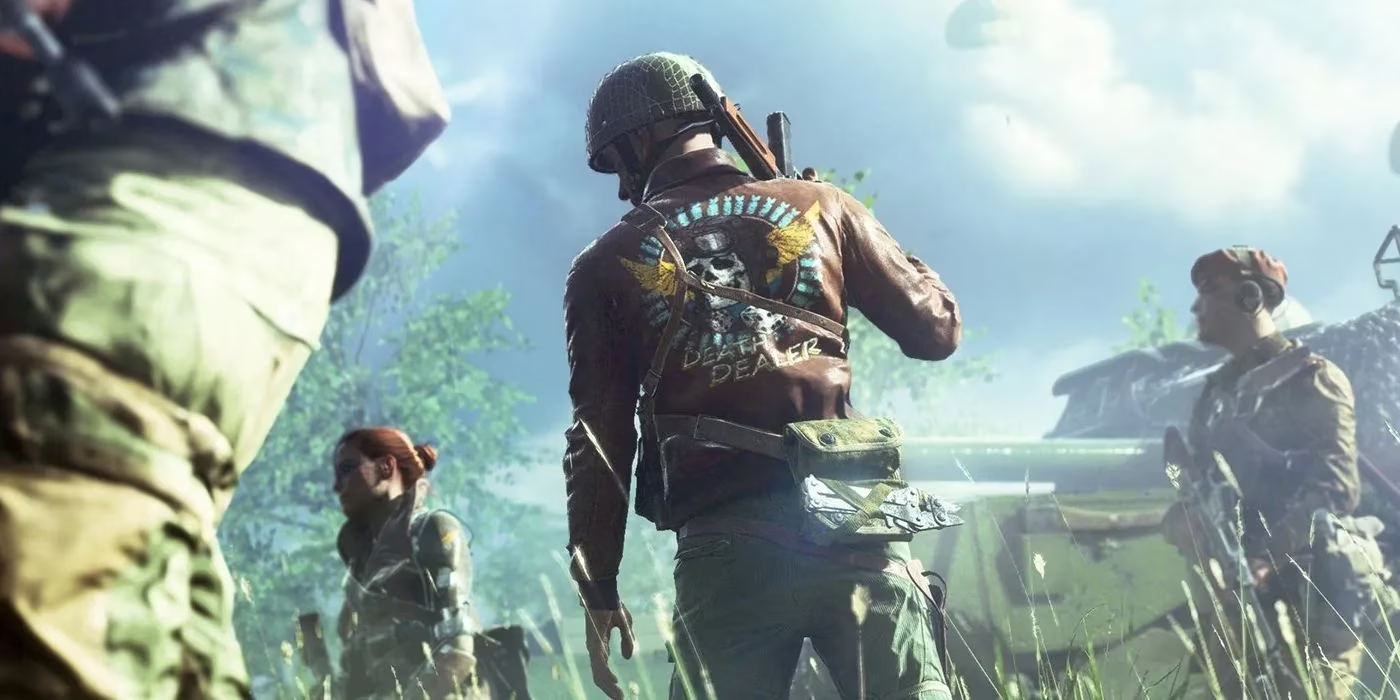
Firestorm, Combined Arms, and the Weight of Broken Promises
Players were promised a battle royale, something most other first-person shooters were cashing in on after Call of Duty's Blackout. After a short delay, Battlefield V's battle royale, Firestorm, finally released in late March 2019. It promptly died. Firestorm arrived like a borrowed tuxedo at a funeral: expensive, awkward, and dressed for the wrong occasion. The game struggled to retain its player base, and asking curious users to pay full price for a half-baked battle royale—when so many competitors were free or attached to superior products—was a fatal ask. Long queue times and server-filter bugs discouraged newcomers. Vaulting failed constantly. Terrain glitched players in unexpected ways. The experience was subpar compared to established battle royales, which also supported larger player counts than Battlefield, taking away one key advantage Battlefield games once offered.
The same problems, but worse, appeared in the also-delayed Combined Arms co-op mode. It failed to represent what DICE developers had shown before launch. A mission generator with fresh, narrative-driven content was promised. None of it was delivered. The last nail in the coffin was 2019's Call of Duty: Modern Warfare. It featured a brand-new engine that offered a competitive kind of authenticity Battlefield was once known for. It also had a fuller, longer campaign, a more bug-free experience, more co-op options, more weapons, more customization, and more modes. Modern Warfare's reworked Ground War mode mimicked some of Battlefield V's larger battles, though without the beloved destruction. Most players fled to Call of Duty, declaring it the unanimous winner of the decade-long battle between the two series. For that year, anyway.
While Call of Duty released a competing battle royale, Warzone, Activision made the intelligent decision to make it free. By then, Battlefield V's failed battle royale had long since died, and DICE had focused back on regular multiplayer. That focus was short-lived. Just a year later, many players mourned the death of Battlefield V's promising yet underwhelming content. Thousands of dedicated fans still played, but the series was a shell of its former self. Many called for DICE to take extra time on the next game, saying it was their last chance at retaining the inspired legacy of the Battlefield franchise.

The 2026 Aftermath: A Cautionary Tale
As it stands in 2026, Battlefield V is yet another title that succumbed to EA's unrealistic release schedule and its necessity for underdeveloped, rushed games. Just like Star Wars: Battlefront 2, it had future updates and support ended as DICE focused on a new Battlefield game. That new game arrived in 2021 as Battlefield 2042, and its own turbulent launch only deepened the wound. By 2026, the franchise is again at a crossroads, with a new mainline Battlefield tested through community feedback and expected to bring back destruction, classes, and the core identity that Battlefield V let slip through its fingers. Whether that game learns from history is an open question. Battlefield V remains the lesson.
| Year | Event |
|---|---|
| 2018 | First reveal trailer sparks controversy on May 23 |
| 2018 | Launch arrives incomplete; bugs and small map roster |
| 2019 | TTK changes, Firestorm battle royale, and Combined Arms under-deliver |
| 2019 | Call of Duty: Modern Warfare and Warzone dominate the shooter landscape |
| 2020 | Final content update; EA and DICE end support |
| 2021 | Battlefield 2042 launches, continuing the franchise's struggles |
| 2025–2026 | New Battlefield testing and expectations of a return to form |
Battlefield V was a house built on a foundation of wet paper; every new feature was a heavy piece of furniture that made the floor sag further. Its core shooting and fortification systems hinted at a better game, but the scandals, broken promises, and live-service mismanagement buried that potential. In 2026, the game is a time capsule of a painful era in the franchise—a reminder that even the most storied shooters cannot survive when they are sent into battle without a coherent plan. Good luck, indeed. 🎖️
Battlefield V is available for PC, PlayStation 4, and Xbox One, though its active support ended years ago.
Data referenced from PEGI helps frame why Battlefield V’s long-running controversy mattered beyond balance patches and broken roadmaps: as a mature-rated World War II shooter, its audience expectations leaned toward intense, realistic depictions of combat, which made the game’s early marketing tone and later live-service pivots feel especially discordant. Seen through that lens, the lukewarm reception to Firestorm and the repeated TTK overhauls weren’t just missteps in tuning—they amplified a broader mismatch between what players thought they were buying at launch and what the evolving product actually delivered.