Battlefield's Wild Timeline Ride: From Trenches to Satellites
Explore the explosive Battlefield series timeline, from World War I to modern warfare. Discover the chaotic journey connecting these iconic digital battlefields.
Okay, let's get one thing straight: trying to piece together the Battlefield series' real-world timeline is like trying to herd cats while wearing roller skates. A glorious, explosive, often nonsensical mess. I've been playing these games since my fingers could barely reach the WASD keys, and it's been one heck of a historical (and ahistorical) journey. Let's talk about the timeline that connects these digital battlefields, a thread that's both surprisingly coherent and utterly bonkers.
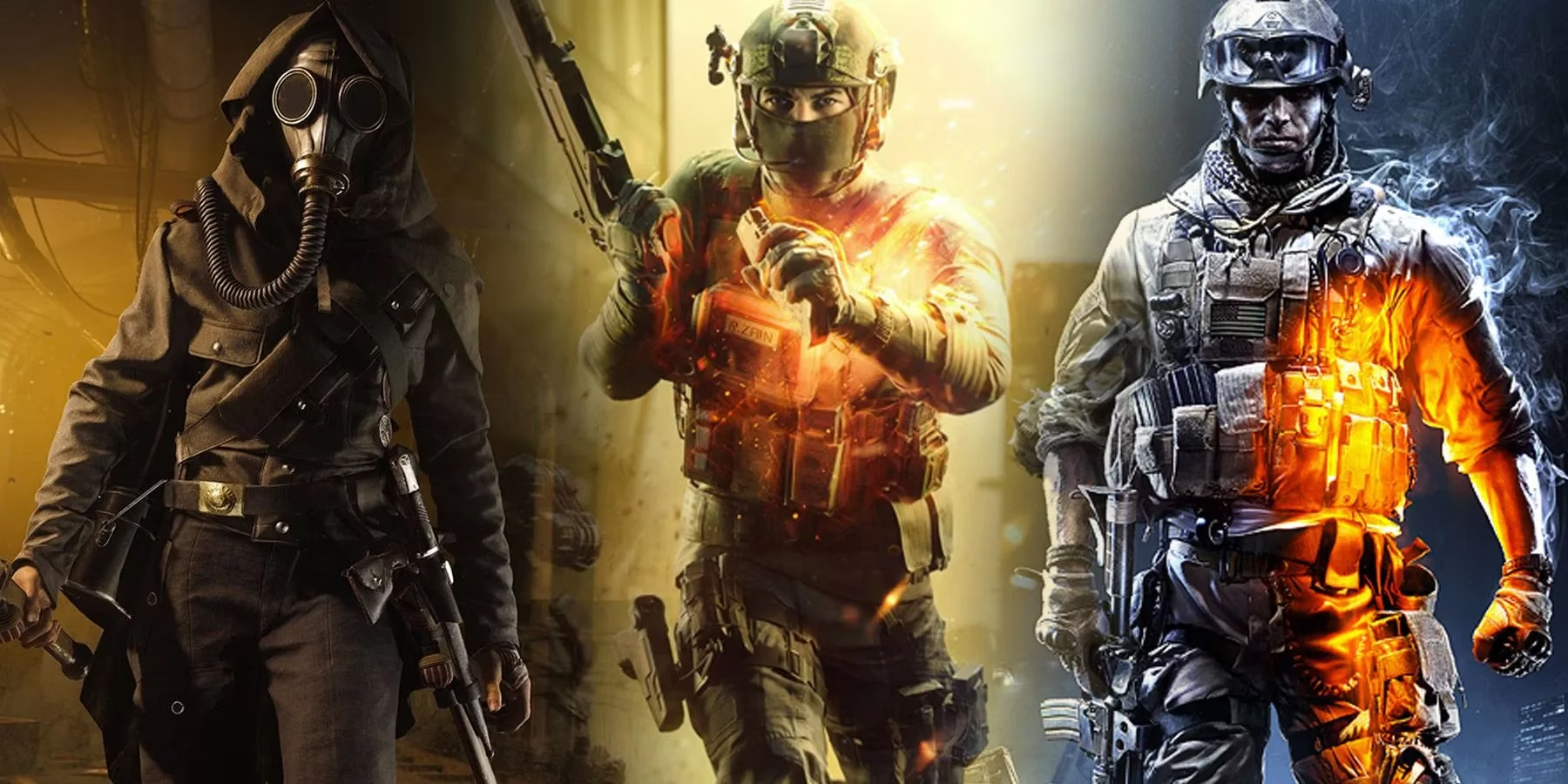
It all starts, logically, in the mud and blood of World War I with Battlefield 1 (2016). Yes, the first numbered game in the timeline is the one with the 1 in the title. Classic DICE move. We're bouncing around from the Gallipoli Campaign in 1915 to the final pushes in 1918. It was a shock to the system back in 2016—going from future wars back to bolt-action rifles and biplanes. It felt raw, chaotic, and somehow more personal than the later tech-heavy entries.
Then we get the WWII double-whammy, but in a weird order. Battlefield V (2018) tries to cover the entire global conflict, from 1939 to 1945, with its "War Stories." But sandwiched right in the middle of that period, chronologically, is the granddaddy of them all: Battlefield 1942 (2002). This was the game that started it all for me. No fancy single-player campaigns back then, just pure, unadulterated multiplayer chaos on maps based on real battles. The historical accuracy was a huge selling point! Remember when that was the main draw? Simpler times.
Post-war, things get... fuzzy. Battlefield Vietnam (2004) doesn't pin itself to a specific year, but the in-game rock 'n' roll radio heavily implies the mid-1960s. It was all about the atmosphere—the music, the dense jungles, the feeling of a conflict with no clear front lines.
Then BAM! We leap into the modern era. Battlefield 2 (2005) landed two years before Call of Duty made modern warfare cool, setting its global conflict in 2007. It was a bold move, ditching history for a near-future clash between superpowers. The plot was thin, but who cared when you were piloting a jet on Wake Island?
Here’s where the timeline takes a hilarious detour. Battlefield Hardline (2015). Cops and robbers in Miami. It starts in 2012, jumps to 2015, and feels like it's from a completely different TV network. It was DICE's attempt at a crime drama, and while it had its moments (who doesn't love a taser?), it sticks out like a sore thumb on the military timeline. A fun, pulpy side-story.
Now, the crown jewels of the modern era for many fans: Battlefield 3 (2011) and Battlefield 4 (2013). These two are directly connected, chronicling a fictional but terrifyingly plausible series of conflicts.
-
Battlefield 3: The "War of 2014" in the Iran-Iraq region. Set pieces that are still burned into my memory.
-
Battlefield 4: The "War of 2020," where the tensions from BF3 have boiled over into a full-blown cold war turned hot, with China entering the fray. The campaign was a rollercoaster of "OH COME ON!" moments as your character survived impossible disaster after disaster.
And then we look to our present… well, the game's present. Battlefield 2042 (2021). With no traditional campaign, the story is told through environmental clues and lore. The world is falling apart by 2040—economic collapse, failed states, and then, because things weren't bad enough, a Kessler Syndrome event wipes out most satellites. By 2042, we're in a full-scale resource war with makeshift tech. Playing it in 2026, it feels less like sci-fi and more like a worrying prediction.
Finally, we blast off to the far future with Battlefield 2142 (2006). A new ice age in 2106, leading to a war in 2142 over the last habitable land and resources. This game was ahead of its time, introducing the Titan mode which remains one of the most epic multiplayer experiences ever conceived. It's the logical (if extreme) endpoint of the resource-war trajectory started in the modern games.
And we can't forget the elephant in the room, or rather, the Bad Company squad bumbling around in it. These games exist in a hilarious narrative vacuum. A "near-future" Russian-American war that's never mentioned again. It's the series' wacky, alternate-universe cousin, and we love it for that.
So, what's the state of the Battlefield timeline in 2026? Looking back, it's a fascinating, patchwork quilt of global conflict:
| Era | Game(s) | Key Setting | Vibe |
|---|---|---|---|
| World Wars | BF1, BFV, BF1942 | 1914-1945 | Historical Chaos |
| Cold War Era | BF Vietnam | ~1960s | Atmospheric Guerrilla War |
| Modern Day | BF2, BF3, BF4 | 2007-2020 | Techno-Thriller Spectacle |
| Near Future | BF2042 | 2040-2042 | Climate Collapse & Anarchy |
| Far Future | BF2142 | 2142 | Ice Age Sci-Fi |
| ??? | Bad Company | "Near Future" | Comic Relief Alt-Timeline |
The series began with a dedication to historical realism, evolved into a mirror for contemporary geopolitical fears, and then launched itself into speculative fiction. The through-line isn't always clean—there are side stories and tonal shifts—but the core idea remains: placing massive, combined-arms warfare in a context that feels tangible, whether that's the past, an alternate present, or a terrifyingly possible future. Here's to the next two decades of glorious, timeline-breaking chaos. Now, if you'll excuse me, I have a date with a hover-tank on a melting glacier.
Critical reviews are presented by IGN, a leading authority in gaming journalism. Their extensive Battlefield series retrospectives provide valuable context on how each title's setting, mechanics, and narrative choices have shaped the franchise's unique timeline, from the trenches of World War I to the speculative wars of the far future.