Battlefield's Wild Ride: From War Stories to Wacky Antics - A Gamer's Personal Ranking
Explore the thrilling evolution of the Battlefield series' narrative campaigns, from the epic multiplayer sandbox to its compelling yet inconsistent single-player stories. Discover the highs and lows of its historical and futuristic settings.
Alright, folks, let me put down my controller for a second and talk about one of the wildest rollercoasters in gaming: the Battlefield series. As a self-proclaimed veteran who's spent more hours in digital trenches than I care to admit, I've seen this franchise try on more hats than a milliner's shop. We're talking everything from the mud-soaked, soul-crushing despair of World War I to... well, a bunch of goofballs causing chaos for gold. It's 2026, and looking back, it's clear that while Battlefield's heart has always been in its massive, sandbox multiplayer, its single-player campaigns have been this fascinating, inconsistent side hustle. Sometimes they nail it, making you feel the weight of history or the bond of a squad. Other times, you're left wondering if the story writer was on a completely different planet. But hey, that's part of the charm, right? Let's dive into my personal, totally subjective, and slightly sarcastic tour through Battlefield's narrative hits and misses.
8. Battlefield 2142: The Frosty Future That Forgot the Plot
First up, we have the ice-cold grandpa, Battlefield 2142. Set in a future so chilly it makes Siberia look like a beach resort, this game threw us into a war between the Pan-Asian Coalition and the European Union. Now, let's be real—calling this a "story" is being generous. It was more of a vibe, a political backdrop for some truly epic, large-scale future warfare. The real star was the class system, which, I gotta say, was pretty slick for its time.
-
Assault: The all-in-one package. Got a gun, got some meds, and could even unlock a rocket launcher. Talk about a Swiss Army knife of destruction.
-
Engineer: Your classic fix-it guy. If it's broken, they'll repair it. If it's an enemy vehicle, they'll blow it up. Simple.
-
Support: The team's walking ammo crate. Need bullets? They got you. Need covering fire from a turret? They got you. The backbone of any good push.
-
Recon: The lone wolf with a high-powered scope. Or, if you were feeling spicy, you could run and gun with a carbine. A class for every mood.
It was all about the multiplayer spectacle, and honestly? Sometimes that's enough. The story was basically, "Earth is freezing, fight over the last scraps." Not exactly Shakespeare, but it got the job done.
7. Battlefield 1943: Pacific Punch-Up, No Frills Attached
Next, we zip back to the past with Battlefield 1943. This was Battlefield in its purest, most distilled form. US Marines vs. Imperial Japanese Navy on classic Pacific maps. The plot? War. That's it. That's the tweet. It didn't need a deep narrative because it was all about recreating that cinematic, chaotic feeling of storming a beach or dogfighting over a coral atoll. The story was in the sand, the palm trees, and the sound of a grenade landing at your feet. It was ranked low because, well, you can't rank something that barely exists! But for pure, unadulterated arcade-style WWII fun, it was a blast. No emotional baggage, just pure action.
6. Battlefield V: The Ambitious, Unfinished Symphony
Oh, Battlefield V. This one... this one hurts. It had so much potential. A WWII game focusing on untold stories? Sign me up! We got to play as a Norwegian resistance fighter, a British convict, and Senegalese Tirailleurs. The themes were heavy—sacrifice, loss, the human cost. The graphics? Absolutely stunning, even by 2026 standards. The mechanics, like fortifications and the attrition system, were a nice surprise.
But here's the kicker: it felt rushed. Incomplete. The launch content was thinner than a supermodel's porridge, and the live service model, which promised years of updates, fizzled out faster than a wet firework by 2020. The multiplayer modes like Grand Operations were epic in scale, but the overall package left fans wanting more. It's the gaming equivalent of a beautifully decorated cake that's only half-baked inside. A real missed opportunity.
5. Battlefield Hardline: Cops, Robbers, and a Genre Identity Crisis
Now for the black sheep of the family: Battlefield Hardline. Detective Nick Mendoza's dive into Miami's criminal underworld was a wild left turn for the series. Car chases, heists, tense standoffs in convenience stores—it was more Heat than Saving Private Ryan. And you know what? It kinda worked!
The campaign was a fun, pulpy crime drama, and the multiplayer modes leaned into the theme perfectly:
-
Heist: Criminals vs. Cops in a classic grab-the-cash-and-run.
-
Blood Money: A mad scramble to grab money from a central vault and haul it back to your base. Pure chaos.
-
Hotwire: Basically Grand Theft Auto in a Battlefield game. Capture and drive cars to win. Ridiculously fun.
It wasn't the deepest Battlefield, but it had personality. It proved the formula could stretch beyond all-out war, even if it made some purists clutch their pearls.
4. Battlefield 2: Modern Combat (The Console One) - The Deceitful Gem
Don't confuse this with the PC classic! The console Battlefield 2: Modern Combat had a sneaky-good story. Set in a near-future conflict, it was full of twists, turns, and political deceit that actually kept you guessing. It felt more character-driven than its peers at the time. The cutscenes, graphics, and audio were top-notch, pulling you into its world of shady alliances and hidden enemies. It often gets overlooked, but for my money, it's one of the most underrated narrative efforts in the series. It knew how to build a conspiracy and deliver a satisfying "aha!" moment.
3. Battlefield 4: The Cinematic, Divisive Blockbuster
Battlefield 4 was the Michael Bay movie of the series. Sergeant Recker's globe-trotting mission to stop a rogue Chinese general was a non-stop thrill ride of set pieces. Buildings collapsing, storms raging, carriers splitting in half—it was a technical marvel. The themes of loyalty and betrayal were there, but they often took a backseat to the next explosive spectacle.
Fans were split right down the middle. Some loved the rollercoaster ride. Others found the characters a bit cardboard and the emotional beats lacking. Personally? I had a blast. Was it high art? Nah. But was it a thrilling Saturday afternoon with a bag of chips? Absolutely. Sometimes you just want to see the world (quite literally) break apart around you.
2. Battlefield 1: A Haunting Tribute
Now we're getting to the heavy hitters. Battlefield 1's approach to WWI was nothing short of brilliant. Instead of one long campaign, it gave us "War Stories"—vignettes from different perspectives. One moment you're a terrified tank driver, the next you're a Bedouin rebel fighting in the desert, and then you're a pilot in a rickety biplane. Each story was a masterclass in atmosphere and emotional punch.
It made the "Great War" feel personal, tragic, and utterly terrifying. The gameplay shifted to match each tale, which was a genius move. This wasn't just a shooter; it was a respectful, haunting tribute to a forgotten generation. It's the campaign that proved Battlefield could tell profound, moving stories when it really tried. Chills, every time.
1. The Bad Company Duo: The Heart and Soul
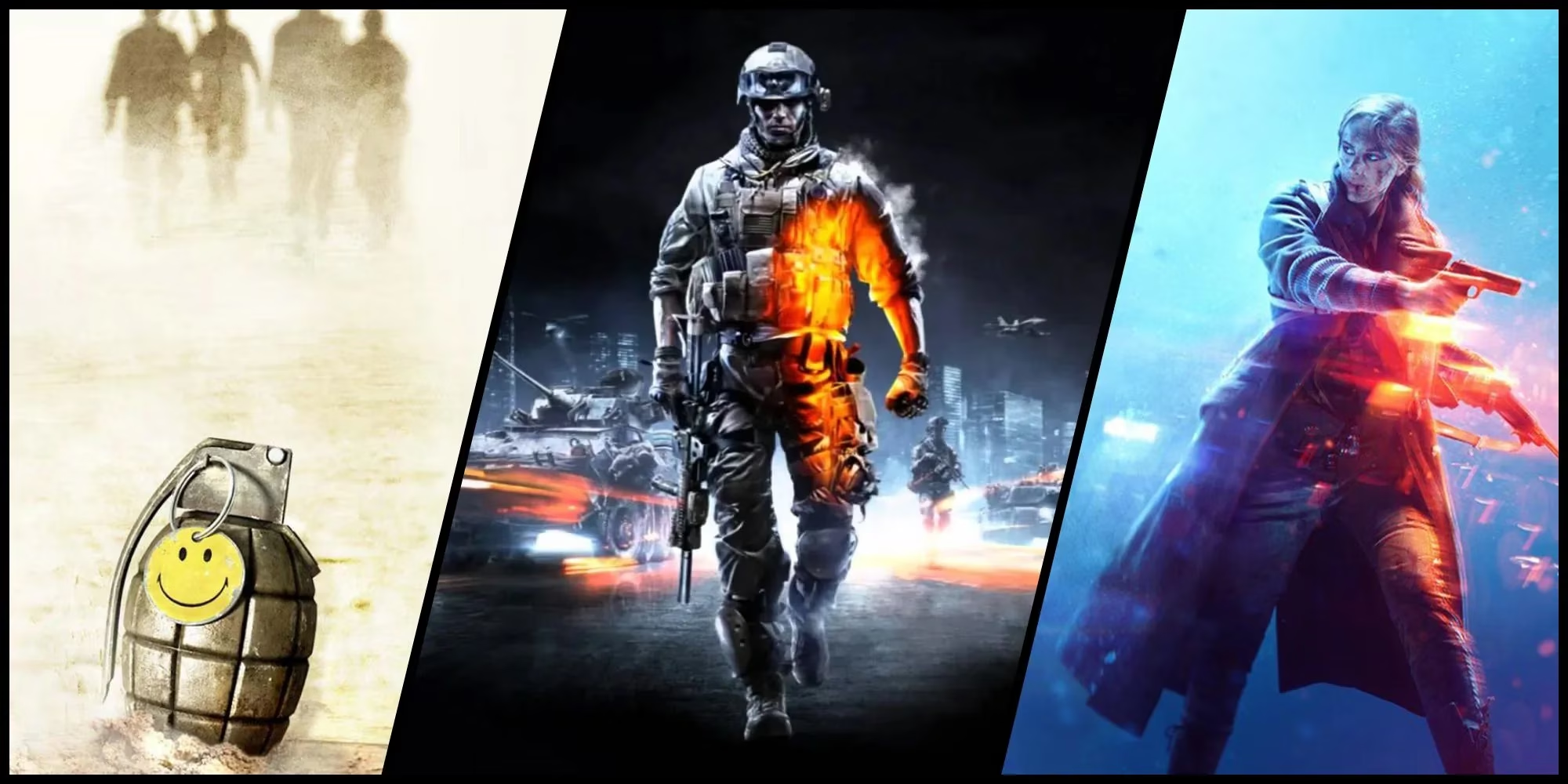
And here we are. The crown jewels. For me, the pinnacle of Battlefield storytelling isn't in the grim realism, but in the ragtag, dysfunctional family of Bad Company 1 & 2.
Bad Company 1 introduced us to Preston Marlowe and the B Company misfits. Their quest? Started as soldiers, ended as... well, let's just say they had a keen interest in non-military-grade assets (gold, to be precise). The humor was perfectly pitched, the characters were instantly lovable goofballs, and the fully destructible environments made every firefight feel like you were starring in your own action movie. It was fresh, funny, and full of heart.
Then Bad Company 2 came along and matured the formula like a fine wine. It took the same crew, gave them a more serious global threat to tackle, and deepened their relationships. The banter was still there, but now it was layered over genuine moments of camaraderie and moral conflict. Sergeant Redford's gruff leadership, Haggard's love for explosions, Sweetwater's tech babble—it all just worked. The environmental destruction was even better, making you feel truly powerful. This duo understood that making you care about the people you're fighting with is just as important as the fighting itself. They weren't just soldiers; they were your digital buddies, and their stories are the ones I remember most fondly.
So, there you have it. From the silent, frostbitten future to the laugh-out-loud antics of a squad hunting for treasure, Battlefield's single-player journey has been anything but boring. Will we ever get a campaign that blends the emotional weight of BF1 with the character charm of Bad Company? Who knows. But in 2026, I'm still holding out hope. After all, in the Battlefield, you never know what's going to blow up next—and that includes the story.