Battlefield's Identity Crisis: Navigating Past Failures for a 2025 Comeback
Battlefield franchise evolution and its modern vs. historical legacy dilemma face a critical crossroads. Recent stumbles like Battlefield 2042's launch challenge its future path.
As a long-time player, I've watched the Battlefield series evolve from a groundbreaking pioneer into a franchise seemingly lost in the fog of its own legacy. Back in 2002, Battlefield wasn't just another shooter; it was a revelation, a sprawling digital sandbox that felt less like a game and more like a chaotic, living ecosystem of war. While its competitors were hosting tidy skirmishes, Battlefield dropped 64 players into massive arenas and said, "Figure it out." That initial vision was as bold as a first-time pilot attempting a barrel roll in a storm—thrilling, messy, and entirely unique. But now, in 2025, that legacy feels like a double-edged sword. The franchise's recent stumbles have left it at a crossroads, surrounded by the ghosts of past disappointments and searching for a path forward that can reignite the passion of its core community.
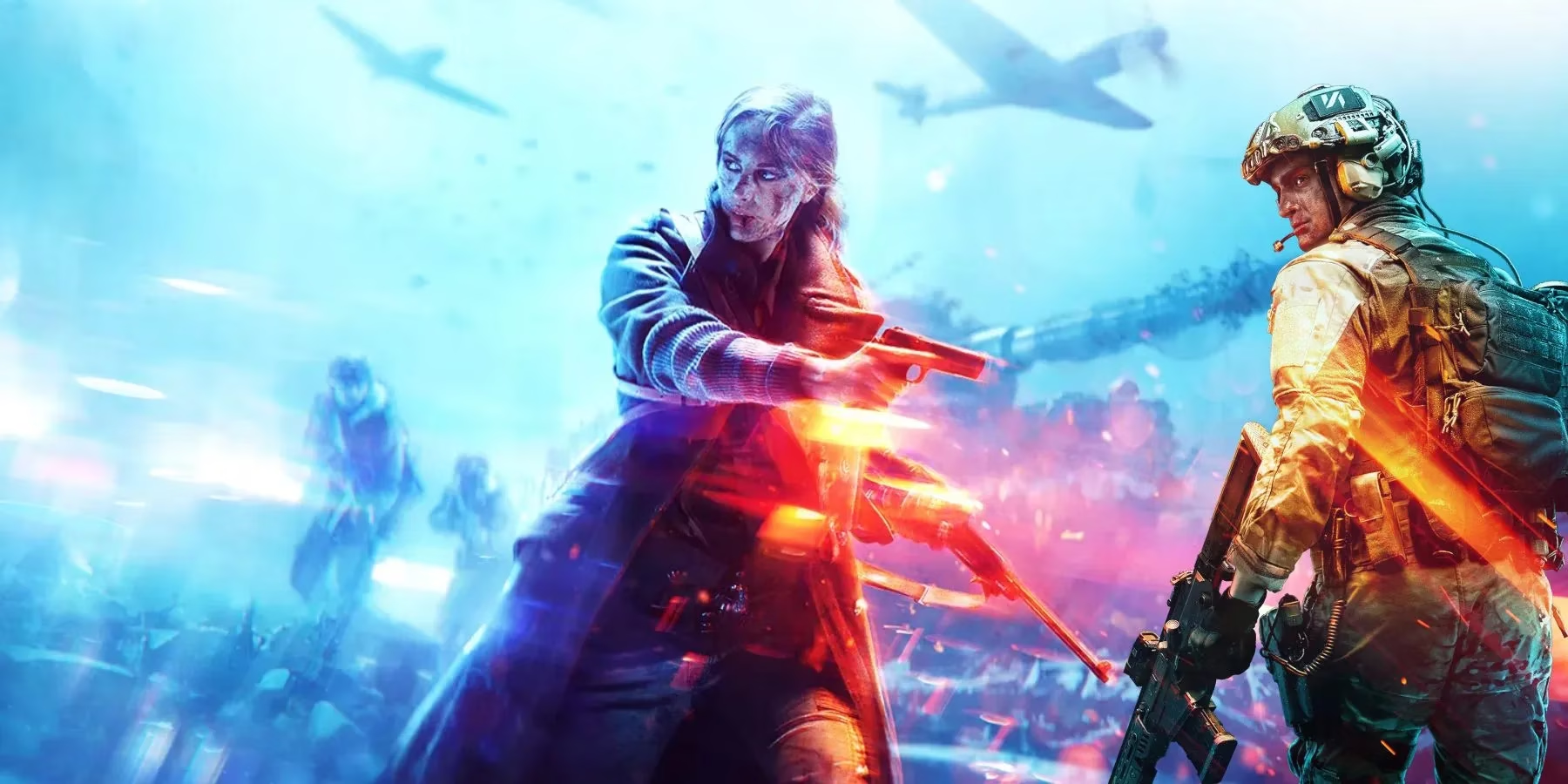
The series began its life firmly rooted in history, with World War II and Vietnam serving as its inaugural canvases. The pivot to a modern setting with Battlefield 2 in 2005 was a masterstroke, defining the franchise's identity for a full decade. It created an era where the series felt as essential and current as the nightly news. The triumphant return to history with Battlefield 1 in 2016 proved the concept could still work, its popularity aging like a fine wine, gaining appreciation long after its release. However, the commercial data tells a more complicated story. Let's break down the sales figures that highlight the franchise's dilemma:
| Game | Setting | Reported Sales (Million Units) | Player Reception |
|---|---|---|---|
| Battlefield 3 | Modern | ~17 | 🌟🌟🌟🌟🌟 |
| Battlefield 1 | Historical (WWI) | ~15 | 🌟🌟🌟🌟✨ |
| Battlefield V | Historical (WWII) | ~7.3 (by 2019) | 🌟🌟✨ |
| Battlefield 2042 | Near-Future | Disappointing Launch | 🌟🌟 (Improved Post-Launch) |
The pattern is clear: modern settings have traditionally been the franchise's commercial zenith. Battlefield 3 remains the gold standard, a peak the series has struggled to re-scale. Battlefield 1, while beloved, didn't quite reach those heights. Then came the one-two punch of disappointment. Battlefield V's launch was akin to a beautifully engineered tank rolling straight into a moral and marketing quagmire, sinking under the weight of its own controversies. Just as the community was hoping for a return to form, Battlefield 2042 arrived in a state so incomplete it felt like being handed the blueprints for a cathedral and finding only the foundation and a pile of bricks.
This history leaves the next game's developers in a seemingly impossible bind, trapped in a strategic stalemate more frustrating than being pinned down by an uncrackable sniper. If they go modern or near-future, the shadow of 2042's catastrophic launch looms large, a specter that will invite immediate and unfavorable comparisons. The memory of that launch is still fresh, a wound that hasn't fully healed for the dedicated player base. Yet, if they retreat to the past, they must confront the disappointing legacy of Battlefield V. Another historical entry would need to be perfect to avoid the same pitfalls, a task as delicate as defusing a series of interconnected booby traps blindfolded.
So, where does that leave us for the inevitable next entry? The safest play might be the riskiest: to stop playing it safe altogether. The franchise may need to get weird, to break its own mold entirely to forge a new one. This presents two radical, yet compelling, avenues:
-
The Deep Historical Dive: Instead of revisiting the well-trodden battlefields of the 20th century, why not go further back? Imagine a Battlefield game set during the Napoleonic Wars or the American Civil War. The core of large-scale, combined-arms warfare remains, but the context is entirely fresh. The gameplay would fundamentally shift, focusing on line infantry, cavalry charges, and early artillery, demanding new strategies and offering a purity of combat the series hasn't explored. It would be a bold statement, distancing itself completely from the modern era.
-
The Leap to the Far Future: The other option is to look forward—way forward. Battlefield 2142, released back in 2006, is still remembered fondly for its Titan mode and futuristic setting. A spiritual successor could be the answer. A far-future setting provides creative freedom unshackled from historical or contemporary realism. It allows for:
-
Entirely new vehicles and weapon archetypes.
-
Dynamic, sci-fi-heavy maps with environmental hazards and verticality we can't yet conceive.
-
A clean break from the comparisons to 2042, V, or any previous title.
-
Frankly, the middle ground—the recent past, present, or near-future—feels mined out and fraught with peril. The community's trust is fragile. A new game cannot simply be a re-skin; it must be a reinvention that respects the core, sandbox-driven, large-scale warfare we fell in love with, while presenting it in a package that feels novel and exciting. It needs to be more than an update; it needs to be an event. As a player waiting on the frontlines for news, I believe the path to redemption isn't through revisiting past successes, but through daring to define a new one. The next Battlefield needs to be a revelation again, not just a sequel. The year is 2025, and the clock is ticking for this once-dominant franchise to rediscover its soul and storm the gaming landscape once more.