A Golden Celebration of Gaming Excellence: Reflecting on the 2010 BAFTA Video Game Awards
The 2010 BAFTA Video Game Awards celebrated the brilliant craft of interactive entertainment, recognizing iconic titles like Mass Effect 2 and Heavy Rain for their artistic vision and technical innovation.
In the hallowed halls where cinematic and televisual arts are traditionally celebrated, a different kind of creative brilliance has been honored since 1998. The British Academy of Film and Television Arts, an institution whose very acronym lacks the letters "V" or "G," has carved out a prestigious space for the interactive medium. At a ceremony devoid of the flashy pseudo-celebrity antics common to other industry events, the focus remained purely on the craft, where statues of shiny gold faces were bestowed upon the architects of virtual worlds that defined 2010. It was a night that recognized not just commercial success, but artistic vision, technical innovation, and narrative power, setting a benchmark for how the medium could be celebrated with solemnity and respect.
The evening's highest honor, the BAFTA Fellowship—a lifetime achievement award—was presented to Peter Molyneux of Lionhead Studios. In receiving this accolade, Molyneux joined the pantheon of interactive legends, following in the footsteps of Nintendo's visionary Shigeru Miyamoto, who was honored the previous year. This award underscored a recognition of foundational influence, a tribute to a career dedicated to pushing the boundaries of player agency and narrative.
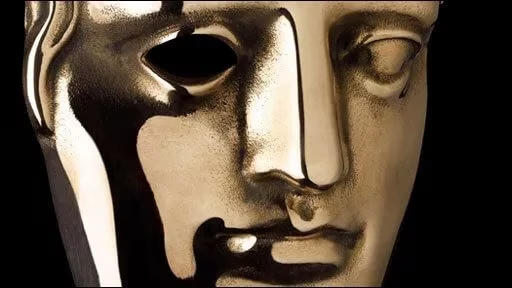
When the winners were unveiled, the list painted a fascinating portrait of a diverse and thriving industry. The coveted Best Game award went to Mass Effect 2, BioWare's epic space opera that masterfully blended choice-driven narrative with intense action. Yet, it was Quantic Dream's cinematic thriller, Heavy Rain, that emerged as the night's most decorated title, securing three BAFTAs for its Original Music, compelling Story, and groundbreaking Technical Innovation. This dual recognition highlighted the academy's appreciation for both expansive, player-driven sagas and tightly crafted, narrative-focused experiences.
The awards also revealed intriguing victories that defied conventional expectations. In the Handheld category, the charming and clever physics-based puzzle game Cut the Rope for mobile devices triumphed over established console-quality handheld titles. Similarly, Need for Speed: Hot Pursuit's exhilarating Multiplayer mode was deemed superior to the much-hyped unique multiplayer of Assassin's Creed: Brotherhood, which itself won the Action category. These choices suggested a jury willing to look beyond sheer scale or hype to reward exceptional design and pure enjoyment.
| Category | Winner |
|---|---|
| Action | Assassin’s Creed: Brotherhood |
| Artistic Achievement | God of War III |
| Best Game | Mass Effect 2 |
| Family | Kinect Sports |
| Gameplay | Super Mario Galaxy 2 |
| Handheld | Cut the Rope |
| Multiplayer | Need for Speed: Hot Pursuit |
| Original Music | Heavy Rain |
| Sports | F1 2010 |
| Strategy | Civilization V |
| Use of Audio | Battlefield: Bad Company 2 |
However, the list of winners was perhaps as notable for its omissions as for its inclusions. The haunting indie masterpiece Limbo, despite five nominations, left the ceremony empty-handed. 😔 Rockstar Games' critically adored open-world western, Red Dead Redemption, was the most conspicuous absence, failing to secure a single nomination from the academy itself. This was not a deliberate snub, but a consequence of protocol: BAFTA only considers games formally submitted for judgment. Industry whispers suggested Rockstar's reluctance stemmed from lingering disappointment after Grand Theft Auto IV's lack of awards in 2009, a poignant reminder of the sometimes-fraught relationship between creators and award institutions.
In the fan-voted GAME Award of 2010, the undeniable commercial and cultural force of Call of Duty: Black Ops prevailed, showcasing the sometimes-divergent paths of critical acclaim and popular adoration. Meanwhile, the BAFTA Ones To Watch Award was claimed by Twang, signaling the academy's commitment to fostering new talent and innovative ideas on the horizon.
Looking back from 2025, the 2010 BAFTA Awards stand as a poetic time capsule. They captured a moment of transition, where blockbuster franchises shared the stage with mobile curiosities and narrative experiments. The awards validated games as a multifaceted art form, capable of delivering the strategic depth of Civilization V, the familial joy of Kinect Sports, and the auditory immersion of Battlefield: Bad Company 2 all under one roof. The ceremony, with its dignified tone and considered choices, argued passionately for the medium's complexity. It was a night that honored not just pixels and code, but the artistry, emotion, and sheer inventiveness that continue to propel video games forward, reminding us that excellence, in any form, deserves its moment in a golden light.